

Market highs can feel like warning signs. History suggests they are often a normal part of long-term investing.
by Austin Boyce, Advisor, CFP®
The halfway point of the year provides a natural opportunity to reflect on what has happened so far and consider what may lie ahead in the months to come.
The first half of 2026 delivered its fair share of financial headlines and market surprises. Despite the volatility and uncertainty along the way, the S&P 500 continued to climb to new heights. Through June, the index has recorded 24 new all-time highs.
For investors, market highs can create mixed emotions. On one hand, it is encouraging to see your portfolio grow and reach new milestones. On the other, it is natural to wonder, "What if this is the peak?" and worry that a market correction may be just around the corner.
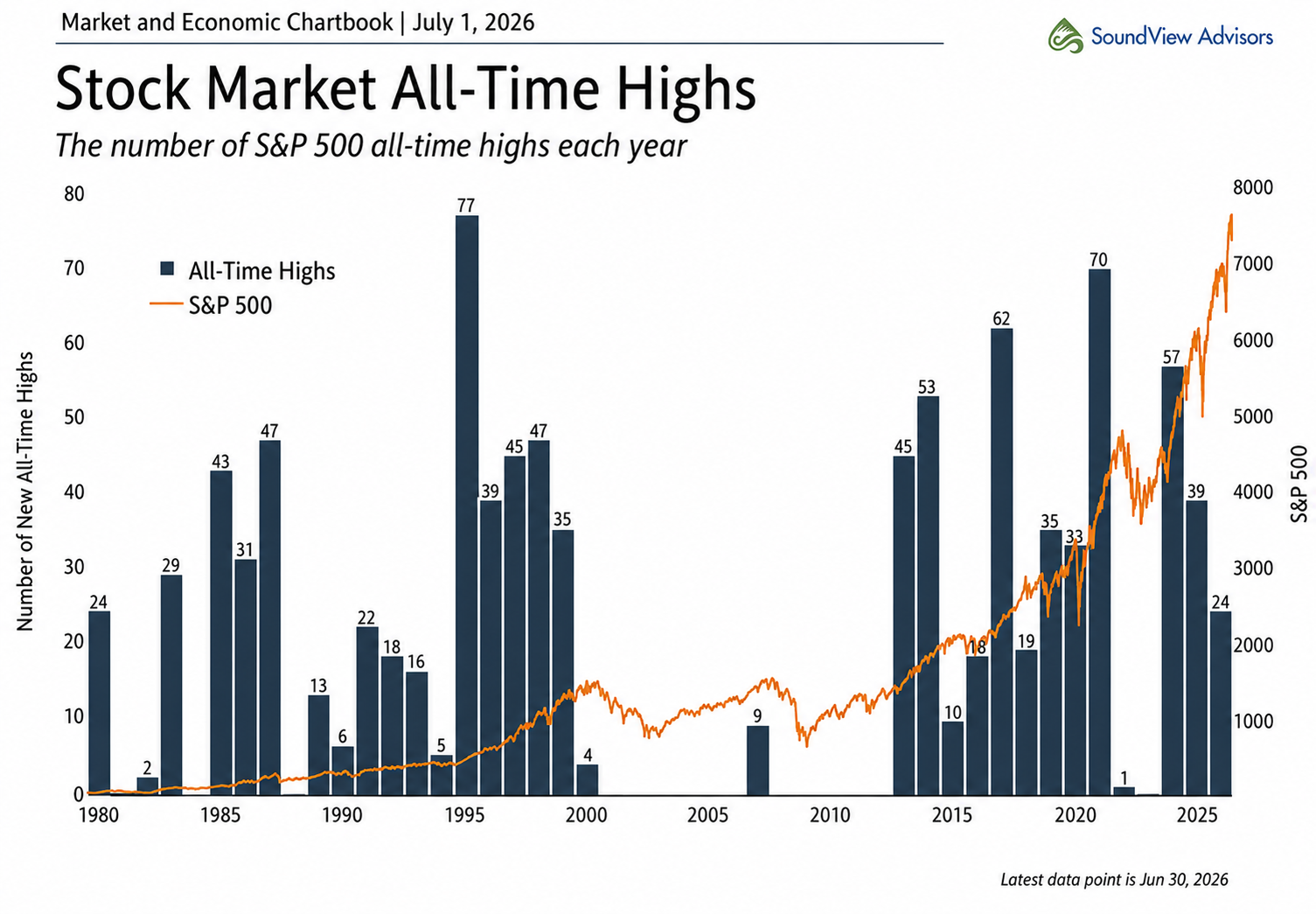
Looking at the chart above, however, we can see that reaching multiple new highs within a year is perfectly normal. In fact, some of the market's strongest years have produced dozens of record highs. For example, 1995 saw 77 new highs, followed by another 39 in 1996.
Of course, there have also been periods when new highs were scarce. During the early 2000s, investors experienced several years without seeing the market reach a new record. Yet even during those stretches, investors who continued to contribute and stay invested benefited from long-term market growth and the opportunity to purchase investments at lower prices.
As we reach the midpoint of 2026 with 24 new all-time highs already recorded, no one knows whether we are in the midst of another extended bull market or approaching a period of more modest returns. The reality is that the future remains uncertain.
Rather than attempting to forecast short-term market movements, we focus on the factors we can control and maintain a long-term perspective.
Your SoundView Advisor is here to help with any questions about your portfolio or financial plan. Our aim is to provide clarity and direction as you navigate the road ahead.